
National park · Seoul / Gyeonggi
Bukhansan National Park
북한산국립공원
Choose a steep summit at Baegundae, a temple and valley walk from Samcheon, or a woodland crossing through Uiryeong. Each starts at a different park entrance.
-
15 Nov – 15 Dec 2026
Autumn fire-season trail closures
The Korea National Park Service closes 148 trail sections in the national parks for the autumn wildfire season: 115 fully and 33 in part. Other trails stay open as usual. Check the closure list for your park before you set off.
Plan your visit
A granite summit, a temple valley or a woodland pass?
Bukhansan National Park includes the Bukhansan and Dobongsan mountain areas, separated by Uiryeong. Pick the landscape and entrance together: the Samcheon bus approach, Baegundae summit trail and Uiryeong crossing have different starting points.
-
A granite summit above Seoul
Baegundae from the Ui side
Start at Baegun Visitor Center, near Doseonsa 백운대탐방지원센터
Choose Baegundae for a steep climb on rock and steps with city views at the summit. The full trail guide covers the approach from Bukhansan Ui Station, the climb from Baegun Visitor Center through Harujae, and the return journey.
Baegundae trail and transport guide -
A temple and its wooded valley
Samcheonsa from Samcheon
Start at Samcheon Visitor Center 삼천탐방지원센터
Start on the Eunpyeong side and follow the temple approach to Samcheonsa and its rock-carved standing Buddha. Make the temple your turning point for a valley outing, then return to Samcheon. The onward route to Seungabong and Samobawi climbs onto the mountain ridge.
Getting to Samcheon -
A woodland crossing between mountain areas
Uiryeong from Ui to Gyohyeon
Start at Uiryeong Visitor Support Center, Ui side 우이령탐방지원센터
Approach from Bukhansan Ui Station, Exit 2, then walk from Uiryeong Visitor Support Center through Obong Observatory to Gyohyeon Visitor Support Center. Plan the journey home from the Gyohyeon side. KNPS currently requires reservations on weekends and public holidays; weekday entry does not require a reservation.
Uiryeong access and reservations
The transport route below reaches Samcheon
The journey starts at Gupabal Station and ends at Samcheon Visitor Center on the Samcheonsa side. For Baegundae, open the separate summit guide from Bukhansan Ui Station. For Uiryeong, use the Ui or Gyohyeon entrance named on the reservation page.
Place details
- Type of place
- National park
Getting there
Start at Gupabal Station, Seoul Subway Line 3
Entrance or stop 삼천탐방지원센터
- Use exit 3 and take bus 7723 at the stop behind the exit. Get off at Hana High School, Samcheonsa and Jingwansa (하나고·삼천사·진관사입구).
- Turn right toward Samcheonsa. Walk up the road for about nine minutes to Samcheon Visitor Center (삼천탐방지원센터).
About Bukhansan National Park
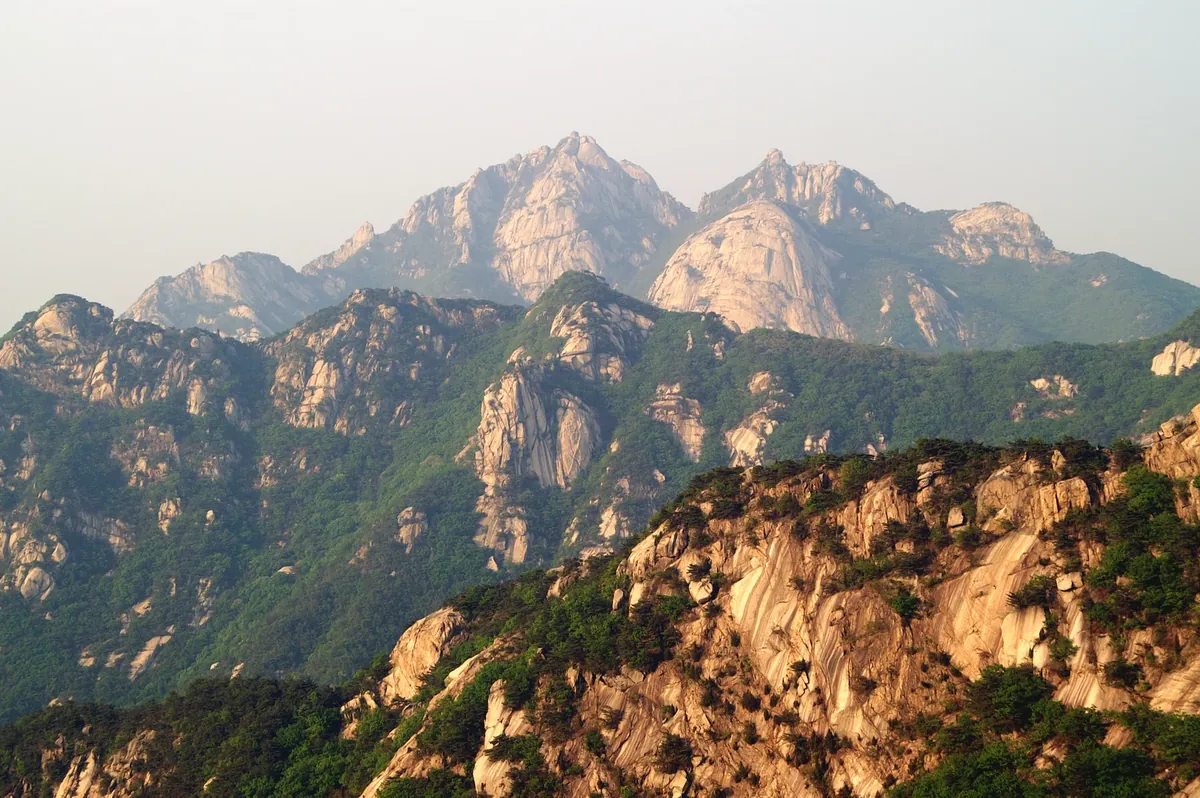
Bukhansan is a natural park inside a city, rare anywhere in the world. Designated on 2 April 1983 as Korea’s 15th national park, it covers about 76.922 km² of Seoul and Gyeonggi, split at Uiryeong pass into Bukhansan to the south and Dobongsan to the north.
Granite intruded in the Mesozoic has weathered into domes, tors, sheet and vertical joints and honeycomb hollows; Insubong, Samo Rock and Gucheon valley are its best-known geology sites, and Seoninbong, Jaunbong, Manjangbong, Uiam and Obong are the great granite peaks of Dobongsan.
Some 1,300 species live among the peaks and clear valleys, with Bukhansanseong fortress and about 100 temples and hermitages. With 8.65 million visits a year (2009 figure), it is listed by Guinness as the national park with the most visitors per unit area.
Worth seeing
- Insubong 인수봉Granite dome and one of the park’s geology sites.
- Bukhansanseong 북한산성Mountain fortress whose history reaches back to the Three Kingdoms.
- Obong 오봉The five granite peaks of Dobongsan.
Written from the Korea National Park Service park introduction.