
National park · North Chungcheong / North Gyeongsang
Songnisan National Park
속리산국립공원
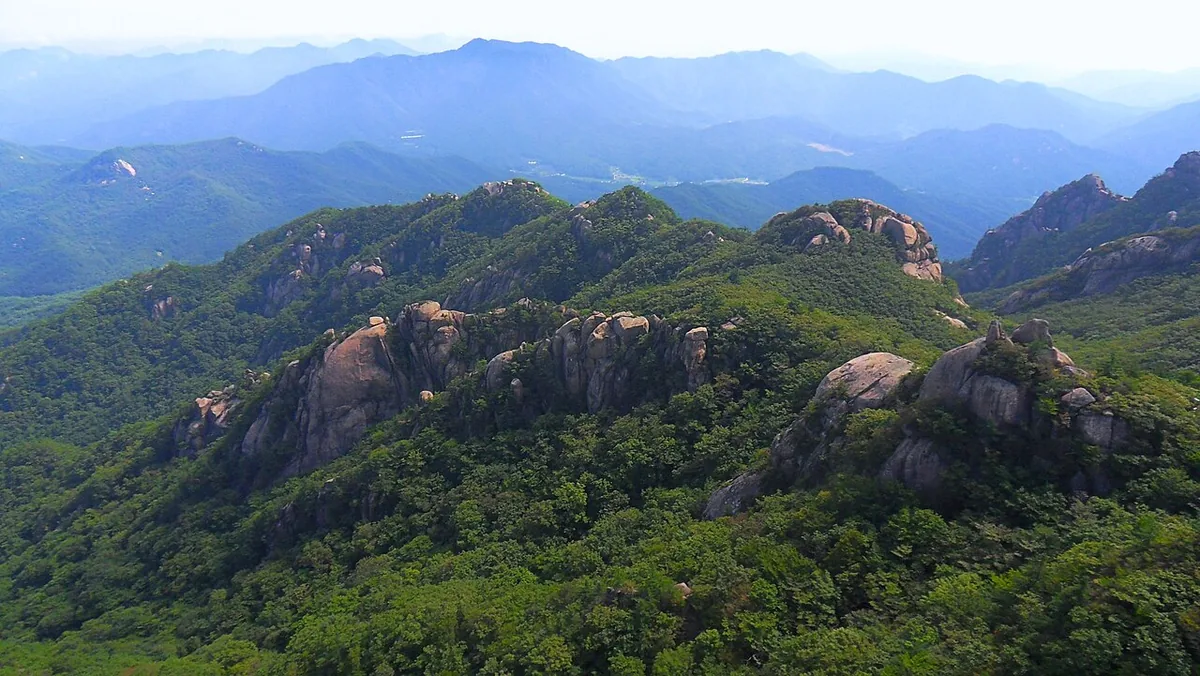
Songnisan National Park: granite peaks to 1,058 m on the Baekdudaegan, Beopjusa temple, Munjangdae and the Hwayang valleys.
-
15 Nov – 15 Dec 2026
Autumn fire-season trail closures
The Korea National Park Service closes 148 trail sections in the national parks for the autumn wildfire season: 115 fully and 33 in part. Other trails stay open as usual. Check the closure list for your park before you set off.
Plan your visit
Walk the forest paths or join a nature programme?
The Beopjusa side of Songnisan offers woodland and valley walks below the granite ridges. Start from the bus terminal for your own walk, or choose the park’s guided nature programme.
-
A woodland outing at your own pace
Orisup and Sejogil
Start at Songnisan Bus Terminal 속리산버스터미널
Follow Orisup through the wooded temple approach to Beopjusa, then continue along Sejogil toward Sesimjeong. The forest, stream and waterside boardwalks are the focus of this outing; return along your chosen section.
Official Orisup and Sejogil walk -
A guided introduction to the forest
Sejogil nature programme
Start at Songnisan Experience Learning Center 속리산 체험학습관
The park’s 2026 nature programme follows the nature-observation trail and Sejogil with explanations of the forest and its stories. It meets in front of the learning centre at 311 Beopjusa-ro and lasts up to 90 minutes. Use the official programme page to choose an available session.
View the nature programme and booking
Arrive at Songnisan Terminal for this side of the park
The bus route below leads to Songnisan Terminal, followed by the Orisup approach to Beopjusa. For a booked programme, continue to the named learning-centre meeting point and use the session time on your reservation.
Place details
- Region
- North Chungcheong · North Gyeongsang
- Type of place
- National park
Getting there
Start at Dong Seoul Bus Terminal
Entrance or stop 법주사
- Check for an intercity bus to Songnisan (속리산) and ride to Songnisan Bus Terminal.
- From the terminal follow the Orisup forest path (오리숲길) on foot to Beopjusa Temple (법주사), the entrance on this side of Songnisan.
About Songnisan National Park
Songnisan, one of Korea’s eight views, stands on the Baekdudaegan where Boeun and Goesan in North Chungcheong meet Sangju in North Gyeongsang. It became a national park on 24 March 1970 and is managed in four districts: Beopjusa, Hwayangdong, Hwabuk and Ssanggok.
Granite rises in sharp peaks while softer metasedimentary rock wears into deep valleys, which earned it the names Gwangmyeongsan, Mijisan and Sogeumgangsan. Around the highest peak, Cheonwangbong (1,058 m), are eight peaks, eight terraces including Munjangdae, Ipseokdae and Sinseondae, and eight stone gates.
The thousand-year-old temple Beopjusa sits among the granite and forest. The park records 906 plant and 2,885 animal species, among them the Jeongipum pine (Natural Monument No. 103), the black woodpecker and the flying squirrel.
Worth seeing
- Beopjusa 법주사Thousand-year-old temple at the heart of the park.
- Munjangdae 문장대One of the eight rock terraces on the main ridge.
- Hwayangdong Valley 화양동계곡Granite valley in the Hwayangdong district, a summer favourite.
Written from the Korea National Park Service park introduction.