
National park · Gwangju / South Jeolla
Mudeungsan National Park
무등산국립공원
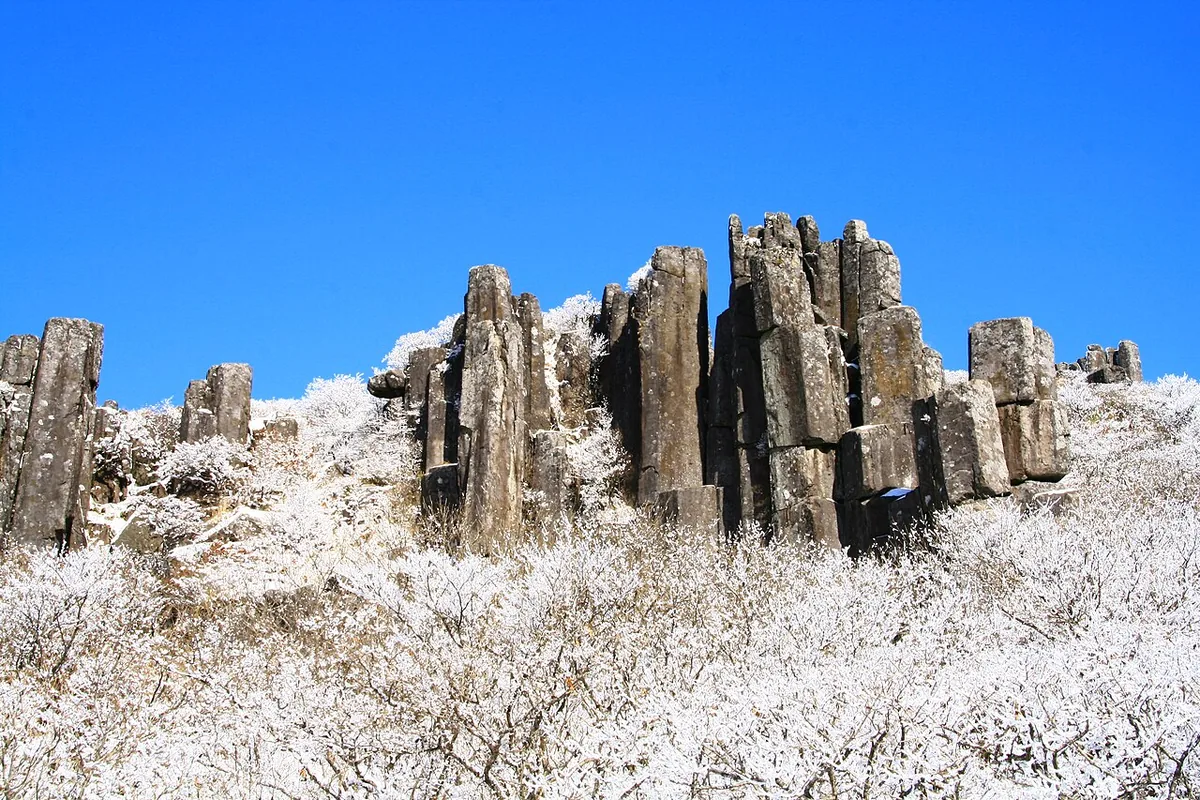
Mudeungsan National Park (75.425 km²), Gwangju: Cheonwangbong at 1,187 m and the columnar-joint pillars of Seoseokdae and Ipseokdae.
-
15 Nov – 15 Dec 2026
Autumn fire-season trail closures
The Korea National Park Service closes 148 trail sections in the national parks for the autumn wildfire season: 115 fully and 33 in part. Other trails stay open as usual. Check the closure list for your park before you set off.
Plan your visit
Choose an approach to the mountain’s geology
Mudeungsan’s stone columns, boulder fields and temple valleys can be explored from more than one side of Gwangju. Jeungsimsa and Wonhyosa are distinct park entrances.
-
A temple valley and boulder landscapes
Jeungsimsa, Jangbuljae and Gyubong
Start at Jeungsimsa park approach 무등산국립공원(증심사)
The official Mu Trail 2 begins on the Jeungsimsa side and links Jangbuljae, Jigong’s boulder field and Gyubong’s columns. Use its named sections to choose your walking destination and return route.
Official Jeungsimsa geology route -
The Seoseokdae and Ipseokdae columns
The Wonhyosa approach
Start at Wonhyosa park approach 무등산국립공원(원효사)
The geopark’s Mu Trail 1 links Wonhyosa with Ipseokdae and Seoseokdae. Choose this side when those columnar rock formations are your main objective, then use the official route to plan the climb and descent.
Official Wonhyosa geology route
The Songjeong journey below reaches Jeungsimsa
The bus destination is the Jeungsimsa park approach, followed by the walk into the valley. For Wonhyosa, use the separate Wonhyosa section in the geopark’s public-transport guide.
Place details
- Region
- Gwangju · South Jeolla
- Type of place
- National park
Getting there
Start at Gwangju Songjeong Station
Entrance or stop 무등산국립공원(증심사)
- At Gwangju Songjeong Station (광주송정역) take bus 좌석02 toward Jeungsimsa.
- Get off at Mudeungsan National Park (Jeungsimsa), 무등산국립공원(증심사). This is the park approach, not the temple itself.
About Mudeungsan National Park
Mudeungsan was made a provincial park on 22 May 1972 and became Korea’s 21st national park on 4 March 2013. Its 75.425 km² lie in Gwangju’s Buk and Dong districts and in Damyang and Hwasun in South Jeolla.
Its defining feature is columnar jointing: polygonal stone pillars that split as erupted lava cooled and shrank. Around the highest peak, Cheonwangbong (1,187 m), the pillars of Seoseokdae, Ipseokdae and Gyubong stand like a stone palisade, and Saeinbong, named for its likeness to a royal seal, is a screen of cliffs west of Jangbuljae.
The park records 4,066 species, 26 of them endangered, including otters, leopard cats and the Korean rat snake, and 145 landscape features of peaks and rocks.
Worth seeing
- Seoseokdae 서석대Columnar-joint cliffs in the summit area.
- Ipseokdae 입석대Columnar-joint pillars near the summit.
- Gyubongam 규봉암Hermitage where the columnar joints show well.
Written from the Korea National Park Service park introduction.